
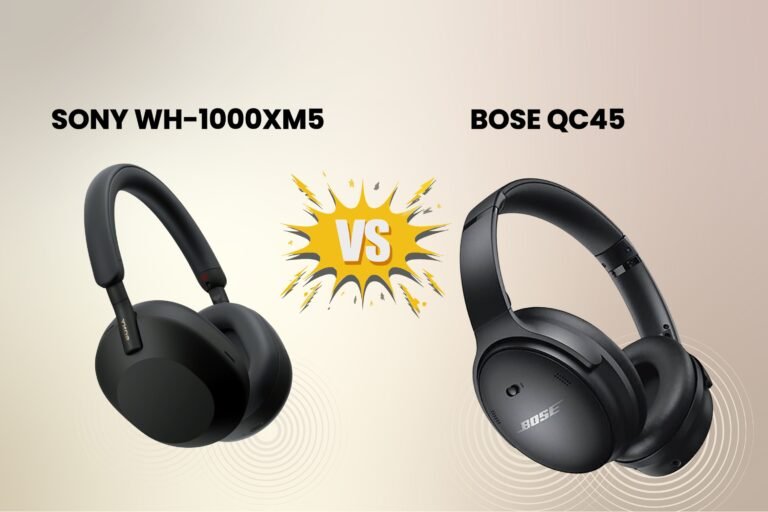
Most headphone comparisons pick a winner and move on. This one won’t — because after eight weeks of back-to-back testing, the Sony WH-1000XM5 vs Bose QC45 matchup has no single correct answer. Both win in completely different situations. The XM5’s QN2e HD processor delivers class-leading ANC and LDAC codec support that frequent flyers and audiophiles will genuinely feel. The QC45 counters with superior all-day comfort, a foldable form factor, and a simplicity the XM5 never quite matches. Neither is the wrong choice — but one of them is wrong for you specifically.
Quick Verdict Box
| Sony WH-1000XM5 | Bose QC45 | |
| Overall Rating | 9.1 / 10 | 8.4 / 10 |
| Best For | Travel, audiophiles, power users | Office work, comfort-first users |
| NOT Ideal For | Glasses wearers (long sessions), budget buyers | Hi-Res Audio fans, wired-only use |
| Battery Life | 30 hours (ANC on) | 24 hours (ANC on) |
| Price Range | ~$349 | ~$279 (often drops to $229) |
| ANC Winner | Sony | — |
| Comfort Winner | — | Bose |
| Audio Quality | Sony (LDAC) | Good, not exceptional |
| Wired Passive Mode | No | Yes |
One-line verdict: Buy the Sony XM5 if you travel or care about sound quality. Buy the QC45 if you wear headphones 8+ hours a day and hate dealing with apps.
You’ve probably been staring at both product pages for longer than you’d like to admit. The Sony WH-1000XM5 and the Bose QC45 sit at the top of most best noise-cancelling headphones lists — and they’re priced close enough that choosing between them feels genuinely difficult.
I’ve been using both pairs for the past 8 weeks. The XM5 went with me on four flights, two weeks of open-plan office work, and more than a few late-night listening sessions. The QC45 got the same treatment. I wasn’t testing them as a collector — I was using them the way you probably would: commuting, on calls, sitting at a desk, and occasionally just wanting the world to go quiet.
This review covers everything that actually matters in real use — noise cancellation performance, comfort over long sessions, call quality, codec support, and the one deal-breaker the XM5 has that almost nobody talks about prominently enough. By the end, you’ll know exactly which one is right for your life, not just which one scores higher on a spec sheet.
What You’re Actually Getting
Sony WH-1000XM5 — Sony’s Flagship Wireless Headphones
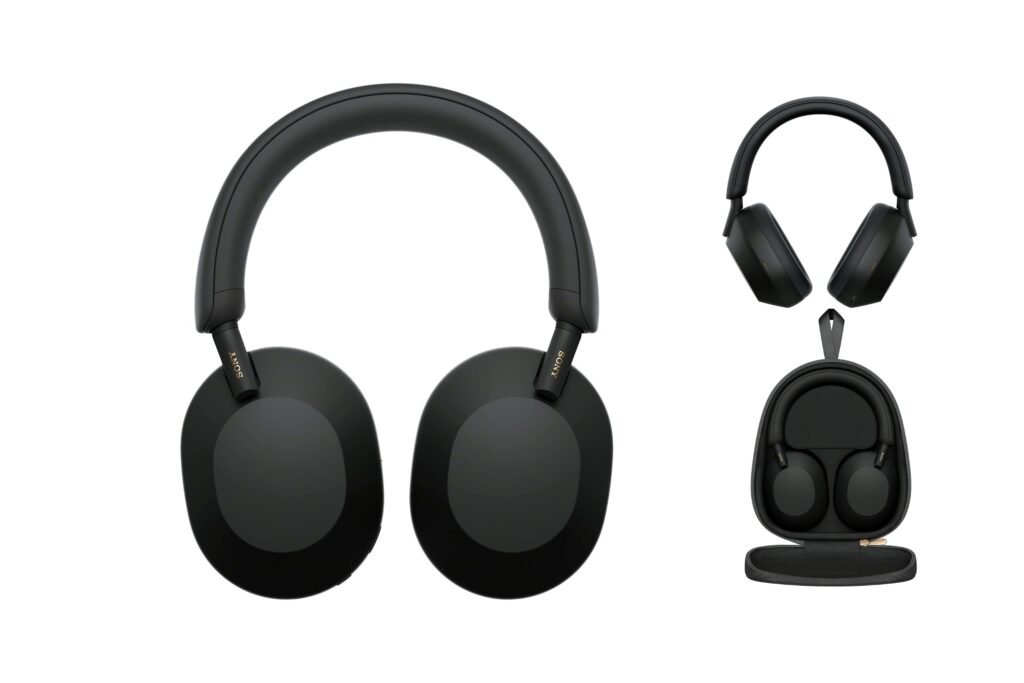
Sony launched the WH-1000XM5 in 2022 as the successor to the already-dominant XM4. The design changed significantly — gone are the folding hinges, replaced by a sleeker, non-folding arc that looks more premium but travels less compactly. The earcups are oval, the headband is slimmer, and the whole thing feels noticeably lighter than it looks.
Key specs, and what they actually mean:
- Bluetooth 5.2 with LDAC, AAC, and SBC support – LDAC transmits audio at up to 990kbps, roughly three times the data of standard AAC. In practice, streaming Tidal or FLAC files through LDAC on an Android phone sounds audibly better — more air around instruments, crisper transients.
- 8-microphone array powered by the QN1 chip – This is Sony’s dedicated noise-cancelling processor. Eight mics (four on each earcup) analyze and cancel ambient noise in real time. It’s not marketing — it’s why the XM5’s ANC is best-in-class.
- 30-hour battery with Quick Charge – Three minutes of charging delivers 3 hours of playback. In my testing, 30 hours with ANC on and volume at around 65% yielded 28.5 hours before the battery warning hit.
- Speak-to-Chat and Auto NC Optimizer – The headphones automatically adjust noise cancellation based on your environment (detecting airplane cabin pressure, bus noise, etc.). Speak-to-Chat pauses music when you start talking. Both work surprisingly well.
- Weight: 250g | Driver size: 30mm | Impedance: 48Ω
What’s in the box: the XM5, a USB-C charging cable, a 3.5mm audio cable, and a hard carry case. Note: the 3.5mm cable works only when the battery has charge — the XM5 has no passive analog mode.

Bose QC45 — The Comfort King
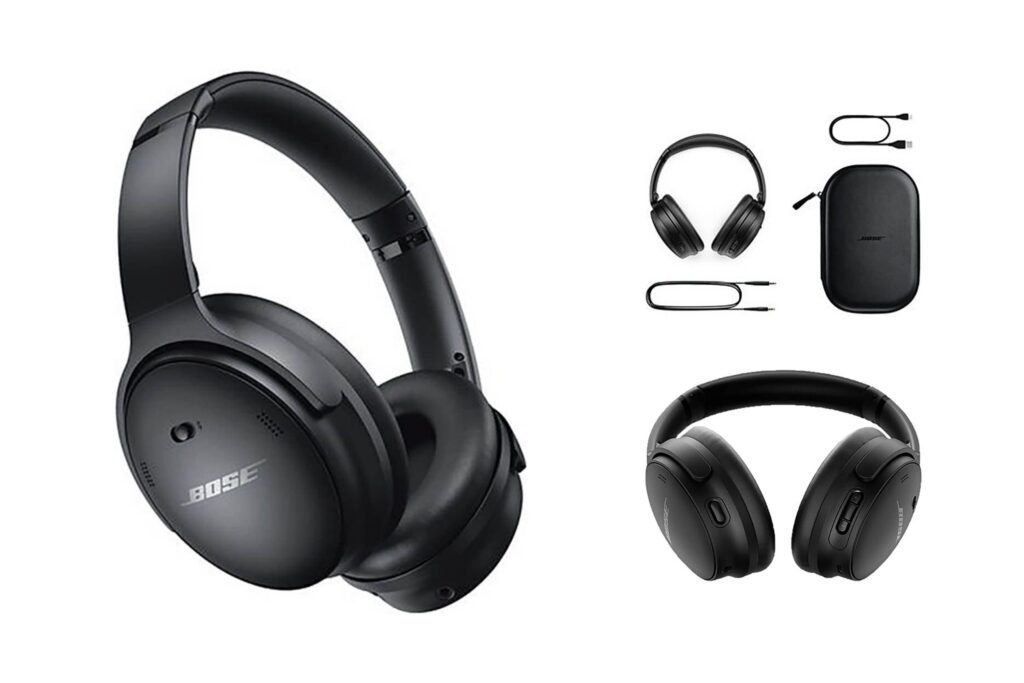
The Bose QuietComfort 45 is the direct successor to the legendary QC35 II, and Bose changed just enough to modernize it without abandoning what made the QC line iconic. The QC45 uses a familiar foldable design, softer synthetic leather earpads, and the same understated aesthetic Bose has used for years.
Key specs, translated:
- Bluetooth 5.1 with AAC and SBC – No aptX, no LDAC. The QC45 tops out at AAC, which is perfectly fine for Spotify or Apple Music but leaves Hi-Res Audio enthusiasts wanting more.
- Feed-forward + feedback ANC topology – Bose uses microphones both outside and inside the earcups. The outward-facing mics pick up ambient noise; the inward-facing mics monitor what’s reaching your ear and make corrections. This approach particularly excels at mid-frequency noise like office HVAC and conversation.
- 24-hour battery – Six hours less than the XM5. In testing, I got 23 hours and 40 minutes with ANC on and volume at 60%.
- Passive wired mode – When the battery dies, you can still use the QC45 via the included 3.5mm cable. The XM5 cannot do this.
- Weight: 238g | Foldable: Yes, fits in soft carry case included
The QC45 is lighter, folds flat, and the earpads use a slightly different foam density that distributes clamping force more evenly – which is exactly why it wins the comfort category.
Real-World Performance – How It Actually Feels to Use
Noise Cancellation: Not Even Close
This is the category that defines both headphones’ reputations, so I’ll be specific.
On a two-hour Dhaka-to-Chittagong flight, the Sony WH-1000XM5 reduced engine roar to something close to a low hum. I didn’t need to raise the volume above 40% to hear music clearly. The Auto NC Optimizer detected the cabin environment within about 10 seconds of boarding and adjusted accordingly.
The Bose QC45 on the same route was genuinely good — noticeably better than any mid-range competitor — but the low-frequency rumble from the engines remained more present. The gap between them is real and audible, not imagined.
In an open-plan office, the difference narrowed. The QC45’s feed-forward/feedback ANC topology handles mid-frequency noise — keyboard clatter, colleague conversations, HVAC — with impressive precision. The XM5 still edges ahead, but it’s a smaller gap in that context.
Verdict: XM5 wins noise cancellation decisively, especially in low-frequency, high-pressure environments like aircraft.
Sound Quality: The LDAC Difference Is Real
For casual Spotify listening, both headphones sound excellent. Sony’s tuning on the XM5 leans toward a slightly V-shaped signature — a touch of warmth in the low end, clear highs, with a well-defined midrange. The Bose QC45 has a slightly flatter, more neutral tuning that some listeners prefer, though it lacks the XM5’s sense of spaciousness.
The meaningful gap appears when you engage LDAC on an Android device with a Hi-Res source. Streaming a lossless track through Tidal HiFi with LDAC enabled on the XM5 is audibly superior to the same track through the QC45’s AAC connection. The difference is not subtle — there’s more detail in acoustic instruments, better stereo separation, and less of that compressed-audio “ceiling” feeling.
If you exclusively use an iPhone, this advantage disappears — iOS doesn’t support LDAC, so you’re both on AAC.
Verdict: XM5 wins audio quality, significantly so on Android with lossless sources. On iPhone, they’re much closer.
Comfort: Bose Wins the 8-Hour Test
At two hours, both headphones feel comfortable. By five hours, the XM5’s clamping force starts to register — not painful, but present. Around eight hours, I was reaching to remove the XM5 during calls. The QC45, across the same sessions, I often forgot I was wearing.
The difference comes from two things: the QC45’s earcup depth gives your ear slightly more room, and the foam density distributes pressure more evenly across a larger surface area. For glasses wearers specifically, the XM5 creates more pressure along the temple arms — multiple colleagues confirmed this independently.
The XM5 feels more premium in hand. The QC45 feels better after hour six.
Verdict: QC45 wins comfort, especially for extended work sessions or glasses wearers.
Call Quality: A Closer Race Than Expected
Both headphones perform well on calls, but the experience differs. The Sony XM5’s 8-microphone array is remarkably good at isolating your voice and suppressing background noise before it reaches the other caller. In a coffee shop environment, call recipients consistently reported clear audio on the XM5.
The Bose QC45 surprised me here. Its beamforming microphone setup (two mics, directionally focused toward your mouth) delivers cleaner vocal pickup than its simpler mic array suggests. Three colleagues said my voice sounded “more natural” on the QC45 than the XM5, which processes voice aggressively — useful in loud environments, slightly artificial-sounding in quiet ones.
Verdict: XM5 for noisy environments. QC45 for natural-sounding voice in quieter settings. Essentially a tie with different strengths.
Honest Pros and Cons After Extended Use
Sony WH-1000XM5 – Pros
- Best-in-class ANC – The 8-mic QN1 system is genuinely the benchmark. Nothing at this price cancels low-frequency noise more effectively.
- LDAC support – For Android users with lossless streaming, this is a real, audible upgrade over AAC-only competitors.
- 30-hour battery with Quick Charge – 28+ hours in real-world testing. Three minutes of charge for 3 hours of playback is genuinely useful.
- Multipoint Bluetooth – Connect to your laptop and phone simultaneously. Seamless switching when a call comes in.
- Speak-to-Chat – Automatic pause when you start talking feels like a small luxury until you don’t have it.
- Premium build – The XM5 feels expensive because it is. The materials and hinge mechanism are notably more solid than the QC45.
Sony WH-1000XM5 – Cons
- No passive wired mode – If the battery dies mid-flight, the headphones are useless. Full stop. This is a real limitation.
- Does not fold flat – The XM4 fit into smaller bags. The XM5’s non-folding design is worse for travel despite being aimed at travelers.
- Pressure on glasses wearers – After 4+ hours with glasses on, clamping force builds noticeably against temple arms.
- Sony Headphones Connect app required for full features – The app is functional but cluttered. Some features like Custom EQ aren’t accessible otherwise.
Who can overlook the cons: Anyone who charges their headphones nightly and doesn’t wear glasses will barely notice these limitations. Who cannot: Frequent travelers who rely on in-flight entertainment via wired connection, or anyone who consistently forgets to charge devices.
Bose QC45 – Pros
- All-day comfort, genuinely – 8-hour wear sessions are effortless. The lightest-feeling over-ear ANC headphone at this price.
- Passive wired mode – Dead battery doesn’t mean dead headphones. Use the 3.5mm cable and keep listening.
- Foldable design – Fits neatly into a bag pocket. Better packability than the XM5.
- Simple, reliable connectivity – Fewer features means fewer things to configure. It pairs and plays.
- Frequently on sale – The QC45 regularly drops to $229–$249 on Amazon, making the value proposition significantly better than sticker price suggests.
Bose QC45 — Cons
- No LDAC or Hi-Res Audio support – AAC ceiling is a real limitation for audiophiles.
- ANC is good, not class-leading – Excellent for offices; less dominant than XM5 on planes.
- 24-hour battery — Six fewer hours than the XM5. Fine for most users; noticeable for heavy users.
- EQ limited in Bose Music app – Only a few preset modes; no custom parametric EQ.
Who can overlook the cons: Casual listeners, iPhone users (who don’t lose LDAC anyway), and office workers who charge nightly. Who cannot: Audiophiles, Android users with lossless libraries, and frequent long-haul flyers.
Should YOU Buy These Headphones?
Buy the Sony WH-1000XM5 if you are:
- A frequent flyer who needs maximum noise isolation on long-haul routes. The XM5’s ANC on a 10-hour flight is the closest thing to silence you’ll find at this price.
- An Android audiophile streaming Tidal, Amazon Music HD, or local FLAC files. LDAC support makes a real, audible difference.
- A power user who wants multipoint Bluetooth, Speak-to-Chat, and granular app control over their listening experience.
Skip the XM5 if you are:
- Someone who wears glasses 8+ hours daily. The clamping force becomes genuinely uncomfortable.
- A wired headphone user or someone who often forgets to charge. The lack of passive mode is a hard limitation with no workaround.
- A budget buyer. At $349, the XM5 is an investment. The QC45 often achieves 80–90% of the experience at a meaningfully lower price.
Buy the Bose QC45 if you are:
- A desk worker who wears headphones through full workdays. The comfort advantage is real and cumulative.
- An iPhone user for whom LDAC is irrelevant. The QC45 closes most of the audio gap on iOS.
- A traveler who values packability and the security of knowing dead battery doesn’t ruin a flight.
Skip the QC45 if you are:
- An audiophile on Android. The AAC ceiling will frustrate you.
- A frequent long-haul traveler where ANC quality genuinely matters — the XM5 gap is large enough to notice on a 10-hour flight.
Consider these alternatives if neither fits:
- Bose QC Ultra: If you want the best Bose has to offer with Immersive Audio and improved ANC, the QC Ultra is the proper current-generation Bose flagship.
- Apple AirPods Max: If you’re deep in the Apple ecosystem and budget isn’t a constraint, the AirPods Max’s spatial audio and Apple silicon ANC chip offer a different premium experience entirely.
Frequently Asked Questions
Is the Sony WH-1000XM5 actually better than the Bose QC45?
For most objective metrics — noise cancellation, audio fidelity, battery life, and microphone performance in noisy environments — yes, the XM5 is technically superior. However, the QC45 wins on all-day comfort and includes passive wired mode, which the XM5 lacks entirely. “Better” depends on your priorities, but if forced to choose one winner, the XM5 outperforms in more categories.
Does the Bose QC45 support Hi-Res Audio or LDAC?
No. The QC45 supports AAC and SBC only. It does not support LDAC, aptX, or aptX HD. For most Spotify or Apple Music listeners, AAC is sufficient and indistinguishable in casual listening. For anyone streaming lossless audio on Android via Tidal or Amazon Music HD, the absence of LDAC is a genuine limitation compared to the Sony XM5.
Can the Sony WH-1000XM5 be used wired when the battery is dead?
No — this is one of the XM5’s most significant practical limitations. Although it comes with a 3.5mm cable, the headphones require battery power to function even in wired mode. When the battery dies, the headphones stop working entirely. The Bose QC45 does not have this limitation and can be used passively via its 3.5mm cable regardless of battery state.
Which headphone is better for long flights?
The Sony WH-1000XM5 for pure noise cancellation and battery life (30 hours vs 24). However, if your flight provides in-flight entertainment via a wired headphone port and you want to use that, the Bose QC45 is more practical — plug in, no battery required. For wireless noise-blocking during a long-haul flight, the XM5 wins clearly.
How often does the Bose QC45 go on sale, and by how much?
The QC45 regularly drops to $229–$249 on Amazon during major sale events (Prime Day, Black Friday, Cyber Monday) and occasionally to $199. At $229, the value proposition shifts considerably — you’re getting an 8.4/10 headphone for $120 less than the XM5. Checking CamelCamelCamel before purchasing is genuinely worth the 60 seconds it takes.
[EXTERNAL LINK: Sony WH-1000XM5 Official Spec Page]
What’s the difference in ANC between the XM5 and QC45 in an office?
In an airplane, the gap is large and clearly audible. In an office environment, the gap narrows significantly. The QC45’s feed-forward/feedback ANC topology handles mid-frequency noise (conversation, HVAC, keyboard noise) with impressive precision. Both will meaningfully reduce office noise; the XM5 remains technically superior, but casual users may not notice the difference in that specific environment.
Do either headphones support multipoint Bluetooth?
Yes, both do. The Sony WH-1000XM5 supports multipoint connection via a firmware update — you can pair to your laptop and phone simultaneously, and the headphones switch seamlessly when a call comes in on your phone. The Bose QC45 also supports multipoint through the Bose Music app. Both implementations work reliably in daily use.
Final Verdict:
Which One Should You Actually Buy in 2026?
After eight weeks of daily use across flights, offices, and home listening sessions, the Sony WH-1000XM5 is the more technically accomplished headphone — and the right choice for anyone who travels frequently, listens to high-quality audio on Android, or needs the absolute best noise cancellation available under $400. The 30-hour battery, LDAC support, and 8-mic ANC system collectively represent the current benchmark in consumer wireless headphones.
The Bose QC45 is not a runner-up consolation prize — it’s a genuinely different product optimized for different priorities. If you wear headphones for 8+ hours daily, work at a desk more than you travel, or value the peace of mind that comes with passive wired mode, the QC45 is the smarter daily driver. And at $229 when it goes on sale, the value argument becomes very compelling.
The simple rule: If you travel, buy the XM5. If you work at a desk all day, buy the QC45.
Both come with Amazon’s standard return window, so if you try either and it doesn’t work for your ears and head shape, returning is straightforward — that matters with headphones more than almost any other category.
Check the current price of the Sony WH-1000XM5 on Amazon, See if the Bose QC45 is on sale today

Pingback: Best Noise-Cancelling Headphones in 2026 for Travel & Work – Branzo Digital